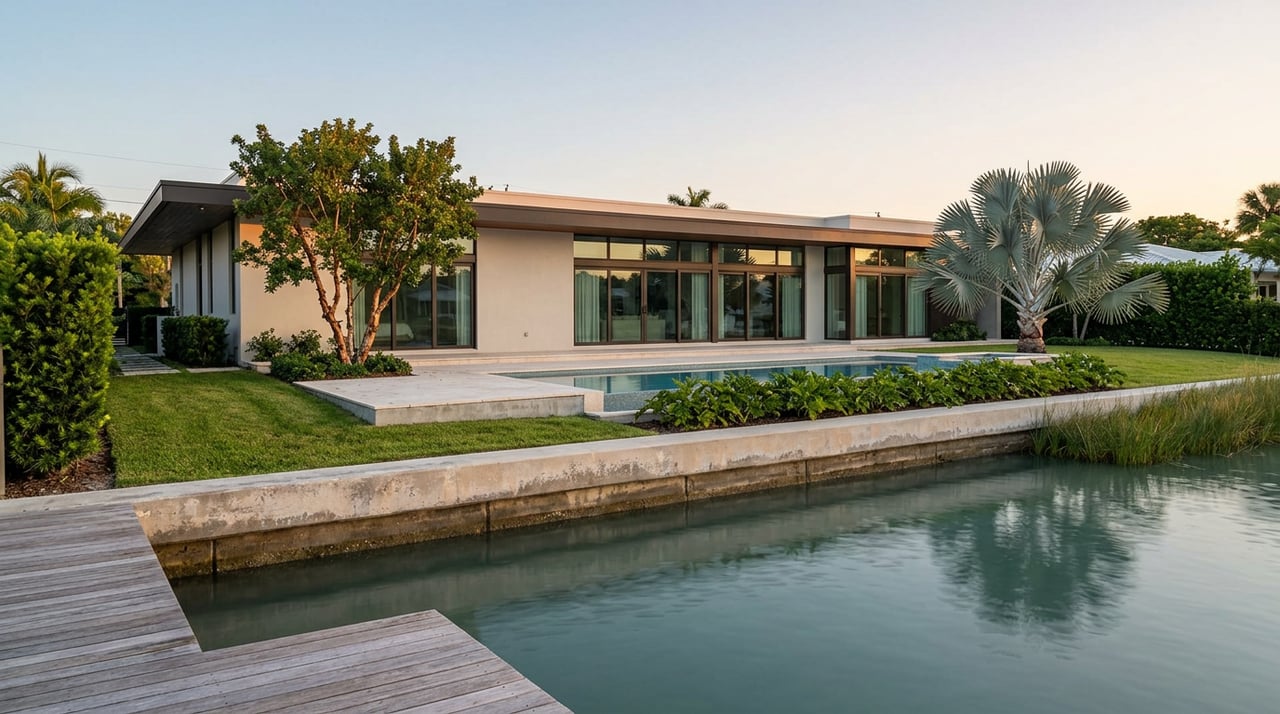
A buyer falls for a canal-front home in Fort Lauderdale, puts down earnest money, and only then walks the route from the dock to the inlet with a chart in hand. That's when the sportfish with the tower comes up against a fixed bridge with 14 feet of clearance at high tide, and the deal that looked perfect on paper turns into a lesson about what "waterfront" actually means in this city.
It's a common enough story that Fort Lauderdale brokers who work with boat owners check bridge clearance before they schedule a showing, not after. And it points to something the median price on a listing sheet never tells you: in Fort Lauderdale, water access isn't one product. It's split by a piece of infrastructure most buyers never think to ask about until it's too late to matter.
The 90 Percent Problem
More than nine in ten of Fort Lauderdale's residential canals have at least one fixed bridge sitting between the dock and open water. Clearances on those bridges typically run somewhere between 12 and 17 feet at mean high water, and the single biggest chokepoint in the system is the 17th Street Causeway, which shapes where larger-vessel owners can realistically keep a boat at home.
That single fact does more to sort Fort Lauderdale's waterfront market than any zip code. A center console with a T-top clears most fixed bridges without a thought. A 35-foot sportfish with a tower usually doesn't. So the real question a waterfront listing needs to answer isn't "is this on the water." It's "how many bridges sit between this dock and the Atlantic, and what's the air draft they allow."
Different Prices, Different Routes to the Ocean
Run that question across the city's best-known waterfront neighborhoods and the map splits into distinct products.
| Neighborhood | Route to open water | Recent price signal |
|---|---|---|
| Rio Vista | Mostly no fixed bridge along the New River corridor, reaching Port Everglades in minutes | Median sale price around $2.6 million as of February 2026 |
| Las Olas Isles | Walkable to Las Olas Boulevard, but many routes require drawbridge transits near the 17th Street Causeway | Median sale price around $4.0 million in January 2026, up 12.8 percent year over year |
| Harbor Beach and Seven Isles | Gated, with direct and largely unobstructed ocean access | Estates commonly listed from $8 million to well past $20 million |
| Coral Ridge | Mixed canal and Intracoastal frontage with larger lots, often 100 feet of waterfront | Single-family waterfront generally ranging $1.2 million to $5 million |
Look at that table long enough and something stops making sense if you assume bridge-free access is what buyers are paying for. Rio Vista offers the cleanest run to the Atlantic of any neighborhood on this list outside the gated estates, and it's the cheapest of the bunch on a median basis. Las Olas Isles, where a meaningful share of routes to the ocean pass through drawbridge territory, commands a materially higher median.
Why the Cheaper Address Sometimes Wins the Better Water
This is the part that a portal search won't surface. The market isn't ranking these neighborhoods by boating utility. It's ranking them by proximity to a lifestyle amenity, and Las Olas Boulevard's restaurants, galleries, and walkable retail carry a premium that has nothing to do with what happens at the dock.
That means a buyer whose top priority is genuinely getting a boat to sea without planning around bridge schedules is being asked, in Las Olas Isles, to pay a walkability premium on top of a compromise they didn't want. Meanwhile Rio Vista, sitting a few minutes south along the New River with a shorter and more direct run to Port Everglades, is pricing in less of that lifestyle tax. The house may be smaller. The lot may be narrower. But the water itself, the actual usable thing a boat owner is buying, can be better for less money.
None of this makes Las Olas Isles a bad address. Plenty of buyers are optimizing for the walk to dinner, not the run to the reef, and that's a completely reasonable trade. The point is that median price alone won't tell a buyer which trade they're making. Only the bridge count will.
The Second Bill Nobody Puts in the Listing
Bridge geometry is the first hidden variable. The second lives underground, in the seawall.
EIN Presswire reports that Fort Lauderdale requires tidal barriers, meaning seawalls, to reach a minimum elevation of 5.0 feet NAVD88. That's stricter than the countywide Broward standard, which phases in at 4.0 feet NAVD88 by January 1, 2035 and rises to 5.0 feet by 2050 under Broward County Policy 2.21.7 and Chapter 39, Article XXV of the county code.
Here's the detail that catches waterfront owners off guard: the trigger isn't a calendar date. It's the scope of a repair. Breezy Permits explains that if a repair touches more than half the linear length of a seawall, or the cost of the work exceeds half the value of the flood barrier, the entire wall has to be brought up to the current elevation standard, not just the section that was failing. A homeowner planning to patch one soft spot can end up owing a full replacement instead, and full replacement on a seawall now commonly runs $1,500 to $2,000 or more per linear foot.
This isn't a distant hypothetical. The city has active seawall replacement and stormwater work underway in Southeast Isles and Las Olas Isles, Rio Vista, along Bayview Drive and Bay Colony, and on Hendricks Isle, which means public infrastructure and private compliance are moving on parallel tracks right now. A seawall that looks fine in a listing photo may be sitting well under the 5.0-foot standard, and a buyer who doesn't ask will inherit that gap the day they need any real repair.
Add in the smaller costs that stack on top of a waterfront purchase, including waterfront-specific HOA assessments that run $200 to $800 a month above standard dues in communities that maintain shared docks and seawalls, occasional dredging assessments of $10,000 to $30,000 per property when a canal silts in, and routine dock repairs in the $2,000 to $8,000 range, and it becomes clear why two homes with nearly identical asking prices can carry very different real costs of ownership.
Before You Write an Offer
A few questions are worth asking before any Fort Lauderdale waterfront contract goes to inspection:
- What is your vessel's air draft, and what are the clearances on every fixed bridge between the dock and the nearest inlet, not just the closest one
- What is the seawall's current top elevation, and how does it compare to Fort Lauderdale's standard described above
- Has any prior repair on the seawall crossed the threshold described above, and if so, is the wall already required to meet current code
- Are the dock and any shared waterfront amenities covered under a deeded easement, and are riparian rights clearly established in the title
- Does the community charge a separate waterfront maintenance fee on top of standard HOA dues, and has that fee increased in recent years
- Has the canal required dredging in the past decade, and is another assessment likely
None of these questions show up in a median price chart. All of them show up in a closing statement.
The Takeaway
Fort Lauderdale's waterfront market rewards buyers who know what they're actually shopping for. If the goal is a five-minute stroll to dinner on Las Olas Boulevard, that address is worth what the market is charging for it. If the goal is getting a boat to the Atlantic without checking a bridge schedule, the data suggests the better value sits a little further south, in a neighborhood that isn't charging a premium for something it was never selling in the first place.
Tatsiana Tobina-Fotiou works this stretch of coast from Delray Beach through the Broward waterfront, and the bridge-and-seawall math above applies just as directly whether a client's must-have is a view, a walk to dinner, or a dock that actually fits the boat they already own. If you're comparing Fort Lauderdale waterfront neighborhoods and want someone to run the bridge clearances and seawall history before you write an offer, Contact Tatsiana at 1 Ocean Realty for a personalized market consultation.
This article is general information, not legal, tax or financial advice. Consult a qualified professional about your situation.