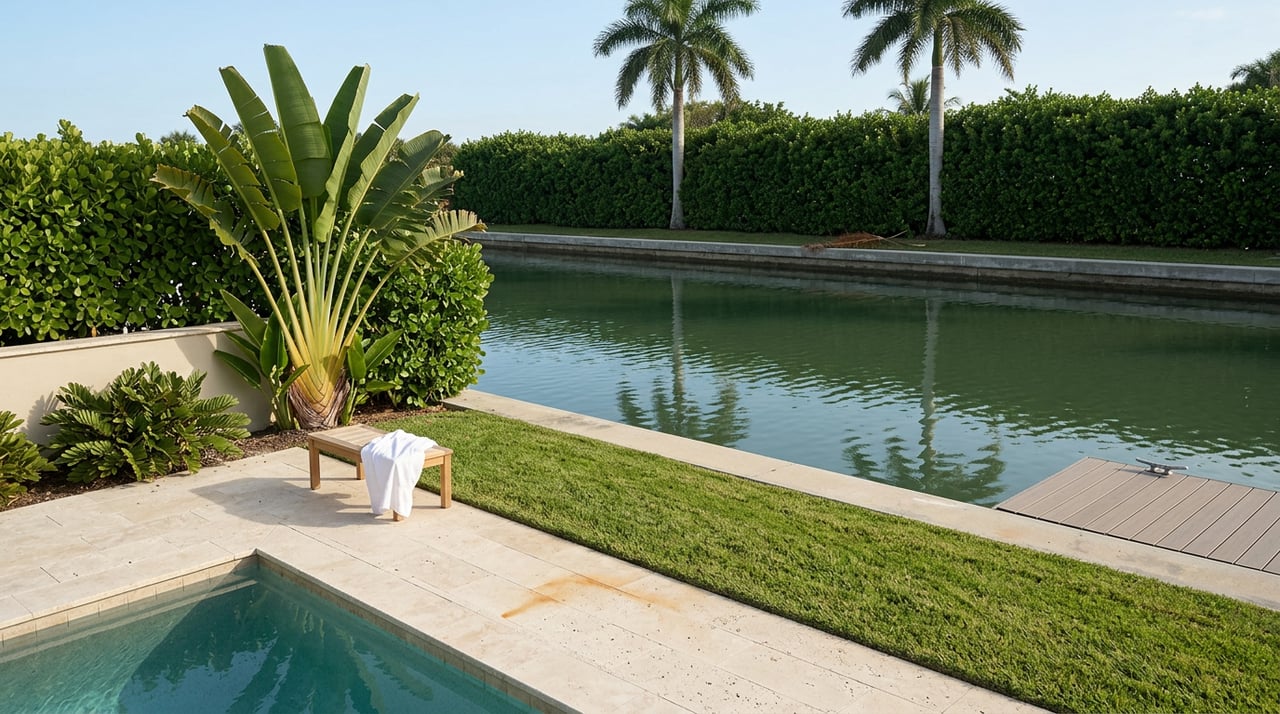
Walk the seawall behind almost any older canal home in Fort Lauderdale and you'll see the same signs: a hairline crack running along the concrete cap, a faint white stain where the tide has been creeping through a joint, maybe a soft spot in the yard a few feet back from the water where the soil behind the wall has started to settle. A contractor looks at that and writes a number. Most buyers treat that number as the risk.
It isn't. The real risk is a percentage, not a price. Buried in Broward County's resiliency code is a threshold that decides whether a repair stays a repair, or becomes a legal replacement at full 2026 elevation standards, and that threshold has nothing to do with what the contractor charges.
Two Contractors, Two Very Different Numbers
If you ask two marine contractors to look at the same wall, you can get two estimates that look like they're describing two different properties.
| Scope of work | Typical cost | What it means for you |
|---|---|---|
| Independent marine contractor inspection | $400 to $800 | Diagnostic only, but the one expense nobody should skip before closing |
| Spot repair, under the code threshold | $150 to $500 per linear foot | Existing wall height can often stay as-is |
| Substantial repair or full replacement | $1,200 to $2,000 or more per linear foot | Must meet Fort Lauderdale's current 5.0 foot NAVD88 standard |
On an 80 to 100 foot lot, that gap is the difference between a repair bill in the low five figures and a project that clears $150,000. Both contractors can be right. What separates them is whether the scope of work they're proposing crosses a line written into county and city code.
The Sentence Buried in the Code
Under Broward County Policy 2.21.7 and Chapter 39, Article XXV, any seawall repair that touches more than half the wall's length, or any appurtenant work whose cost exceeds half of what full replacement would run, is legally classified as a substantial repair rather than a patch job. Once that happens, the entire wall has to meet current elevation standards, not just the section that was failing.
"a seawall 'repair' that touches more than half the wall legally requires the whole structure raised to current elevation"
That's the trap a Pompano Beach-based marine contractor flagged in a June 2026 industry advisory aimed at waterfront owners across Palm Beach and Broward counties: a homeowner budgets for a repair, gets a quote for the section that's actually cracked, and only learns partway through permitting that the code has reclassified the job.
Here's the part that catches people off guard even more. Broward's countywide standard phases in over time, 4.0 feet NAVD88 by January 1, 2035, and 5.0 feet by 2050. But Fort Lauderdale doesn't run on the county's slower clock. The city raised its own minimum from 3.9 feet to 5.0 feet NAVD back in March 2023, and that higher bar already applies today to any new seawall, or any wall reclassified as a substantial repair. A buyer who assumes they have until 2035 to worry about this is thinking about the wrong deadline.
There are three situations that trigger the requirement in Fort Lauderdale specifically: building a brand-new wall, a wall in significant disrepair that meets the substantial-repair definition, or a wall low enough that it's actively flooding a neighboring property. The city isn't guessing on that third one either. Code enforcement officers patrol the canals by boat, and owners who don't comply within the compliance window face fines of $100 per day.
The City Already Rebuilt Its Own Walls to This Standard
This isn't theoretical. Fort Lauderdale has spent the last several years applying this exact rule to its own infrastructure, and the paper trail is public.
On Hendricks Isle, the city replaced roughly 325 linear feet of aging coral-rock seawall with marine-grade steel sheet piles and a new concrete cap set at 5.0 NAVD, partly funded through a Florida Resilient Coastline Program grant. Along Las Olas Boulevard in the Las Olas Isles and Southeast Isles neighborhoods, the city worked with Poseidon Dredge & Marine to replace four separate segments of city-owned wall, 104 feet, 89 feet, 101 feet, and 95 feet, each rebuilt to the same 5.0 foot NAVD cap elevation, with new stormwater tie-ins added at every segment. And in Rio Vista, the city completed a new seawall along Cordova Road between SE 7th Street and SE 12th Street, a project residents in the neighborhood have pointed to as a reminder that waterfront value in this city is now tied as much to infrastructure as it is to scenery.
None of these were optional upgrades the city chose to make for appearance. They were the same substantial-repair standard private owners are held to, applied at municipal scale.
Why the Threshold Bites Harder in Some Neighborhoods
Not every canal in Fort Lauderdale ages the same way. Tidal saltwater canals connected to the Intracoastal or the New River put more stress on a wall than the freshwater retention canals scattered through the city's western neighborhoods, and older aluminum-cap walls in particular can hide deterioration that isn't visible from the yard. That matters because Fort Lauderdale's most established waterfront neighborhoods also tend to have its oldest walls. Rio Vista, one of the city's earliest platted communities, mixes 1950s-era homes with new construction, and entry points there run from roughly $1.5 million for a renovation project up to $6 million or more for a finished custom home on a wide lot. Las Olas Isles spans an even wider range, from around $1.8 million for a dated three-bedroom to $8 million or more for new construction with a deep-water dock. On the more accessible end, Lauderdale Isles offers canal-front entry around $500,000, and Sailboat Bend puts river-front homes within reach in the $700,000 range.
A seawall that turns out to need substantial repair doesn't scale down just because the home is at the lower end of that range. The linear footage, and the cost per foot, stays roughly the same whether the house behind it is worth $700,000 or $8 million. That's precisely why the math changes the calculus more for a starter waterfront buyer than for someone purchasing at the top of the market.
Before You Write the Offer
- Hire a licensed marine contractor for an independent seawall inspection, separate from your general home inspector. Budget $400 to $800 and treat it as non-negotiable on any canal-front property.
- Ask the contractor directly what percentage of the wall's length their proposed scope touches. If it's near or over half, ask them to confirm in writing whether the work qualifies as a substantial repair under Broward's code.
- Pull the permit history on the seawall and any dock through the city's building permit system. An unpermitted repair from a prior owner can become your liability at closing.
- Confirm the wall's current top elevation against the 5.0 foot NAVD88 standard. A wall already at or above that height carries meaningfully less risk than one sitting several inches below it.
- Use whatever you find as a starting point for negotiation, not just a disclosure checkbox. A wall that's one bad storm season away from a substantial-repair classification is leverage on price, not just a line item for your own future budget.
Frequently Asked Questions
Does every waterfront home in Fort Lauderdale need a 5-foot seawall right now? No. City officials have been clear that most homeowners won't be required to raise an existing wall unless they're building new, undertaking a repair that meets the substantial-repair definition, or their wall is causing tidal flooding on a neighboring property.
What exactly counts as touching half the wall? Under Broward's code, it's measured either by linear footage, work along more than 50 percent of the wall's length, or by cost, appurtenant work exceeding half of what a full replacement would run. Either one can trigger the reclassification.
Who's responsible for paying to bring a wall into compliance, buyer or seller? The code doesn't assign that. It's a negotiation point, which is exactly why an inspection before you write an offer matters more than one after you've already waived contingencies.
Are neighboring Broward cities on the same deadline as Fort Lauderdale? Not exactly. The county's regional standard phases in through 2035 and 2050, but Fort Lauderdale adopted its own stricter 5.0 foot requirement years ahead of that schedule, and it applies today to any new or substantially repaired wall within city limits.
Seawall condition isn't something you can read off a listing sheet, and by the time a repair estimate lands in your inbox, you're already negotiating from a weaker position than you were during due diligence. If you're evaluating a canal-front property in Rio Vista, Las Olas Isles, or anywhere else along Fort Lauderdale's waterways, 1 Ocean Realty can walk the property with you, help line up the right marine contractor, and make sure the number on your offer accounts for what's actually below the waterline. Contact Tatsiana for a personalized market consultation before you write that offer.